Why we do what we do
Technology matters only when it helps people deliver better care.
Simon Sinek’s idea of starting with “why” has resonated with so many people because it asks a deceptively simple question. Not what do you make? Not how do you make it? But why does your organisation exist in the first place?
For Black Pear, the answer has never been the technology itself.
We exist to improve health and care by helping the people who deliver it make better-informed decisions—and by enabling citizens to understand and take a more active role in their own health journey. Our role is to ensure that the right information reaches the right person at the right time, in a form they can understand and act upon.
That is our why.
A very human starting point
My own journey in health technology began as an NHS GP. I saw at first hand that good care depends on people: the clinician who listens, the paramedic making a difficult decision, the carer who knows what matters to someone, and the patient whose wishes should guide everything that follows.
I also saw how often those people were being asked to work without the full picture.
Over the years, the technology changed dramatically. We moved from paper records to structured GP systems, from structured records to population analytics, and then from information locked inside the consulting room to information that could be accessed on mobile devices.
When Black Pear was founded in 2009, the iPhone had shown us that powerful digital tools no longer needed to be tied to a desk. We realised that health records could move out of the surgery and into the hands of the people delivering care wherever it was needed.
That was an exciting technical possibility. But the possibility was never the purpose.
The purpose was to help a clinician standing beside a patient make the right decision.
The problem is not simply access to more data
Healthcare now creates an enormous amount of information. Yet having more information does not automatically lead to better care.
If a paramedic has to search through pages of irrelevant detail to discover a person’s end-of-life wishes, the information may technically be available, but it is not truly useful. If a care plan is stored as a static document that nobody can update, it is shared in name only. If one service cannot see what another has agreed with the patient, the technology has failed to support the care pathway.
The challenge is relevance: finding what matters in that moment and presenting it clearly, safely and in context.
This is why we listen so closely to frontline teams. We do not begin with a fashionable technology and look for somewhere to apply it. We begin with a real clinical need and work backwards from the decision that a patient, clinician or carer needs to make.
Our values are visible in the choices we make
Values only mean something when they shape our actions. At Black Pear, ours can be seen in how we design, build and work with others.
We put people before technology. The future of healthcare will be delivered by people, not by software. Our job is to give those people better tools: tools that reduce friction, make important information visible and leave more room for human judgement and compassion.
We do things the right way, not simply the easy way. In healthcare, shortcuts have consequences. Clinical safety, information governance, audit trails and clear permissions are not boxes to tick at the end of a project. They are part of the product from the beginning. The same principle guides our use of AI: it should assist people within transparent, governed workflows, never obscure responsibility or replace clinical judgement.
We believe openness creates better care. Healthcare is too important to be trapped inside organisational or supplier boundaries. We build on open standards such as HL7 FHIR, avoid unnecessary vendor lock-in and collaborate with clinical, technical and interoperability partners. The best answer is rarely one company keeping everything to itself.
We make complexity feel simple. Connecting clinical systems safely is difficult. Using the result should not be. Frontline teams need clear, role-specific information, not a lesson in the integration work beneath it. We take on that complexity so that the experience at the point of care can remain straightforward.
We keep innovating—but always with a purpose. Black Pear has often moved early, from mobile access to GP records to cloud-based data exchange and HL7 FHIR. We are proud of that history, but being first is not enough. Innovation earns its value only when it solves a real problem and produces a better outcome.
We use our skills where we believe they can do good. Not every worthwhile piece of work begins with a commercial return. Sometimes the reason to act is simply that we have something useful to contribute and believe it is the right thing to do. Our pro bono work with the Public Health Collaboration is an important expression of that belief.
What our “why” looks like in the real world
Purpose should be visible in results, not just words.
In Humber and North Yorkshire, making end-of-life care plan information available to ambulance crews has helped more people receive care aligned with their wishes. The programme’s 2025/26 findings reported more than 5,000 avoided ambulance conveyances, over 20,000 hospital bed nights expected to be freed and £3 million in modelled savings.
Those figures matter. But behind every figure is a human moment: a paramedic able to understand what has been agreed, a family spared an avoidable hospital journey, and a person receiving care in the place they wanted to be.
That is why interoperability matters.
It is not about moving data for the sake of it. It is about helping people see the whole patient rather than one isolated slice of their life. It is about turning a shared record into a shared understanding—and that understanding into better care.
From patient to citizen: Elevate
Our purpose does not begin when someone becomes a patient, and it does not end when they leave a consultation.
Most health is shaped in the rest of life: in what we eat, how we move, how we sleep, how we feel and the habits we build over time. In that context, the word patient is too narrow. A person should not need to be unwell or receiving treatment before technology helps them understand their health.
Elevate starts with the citizen, not the patient.
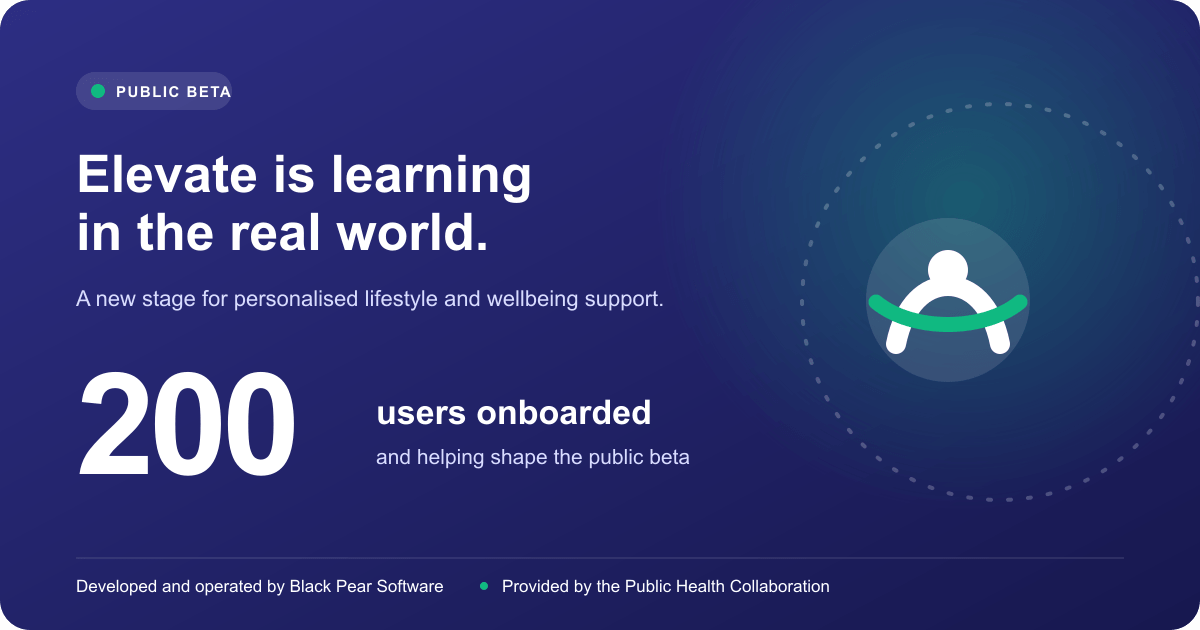
It brings structured information about nutrition, activity, sleep, mental wellbeing and health measurements into one place. Its AI-supported health coach helps citizens explore their own information, recognise patterns and make informed, sustainable changes. Where someone chooses to work with a practitioner, they remain in control of what they share, with explicit permissions and an auditable record of that choice.
We have developed Elevate pro bono for the Public Health Collaboration, a charity working to improve metabolic health.
We made that commitment because we believe it is the right thing to do. If the experience, technology and infrastructure we have built for healthcare can help a charity give more citizens access to practical health support, then applying those skills is part of our purpose. It shows that our values are not just a statement about how we earn revenue; they guide where we choose to invest our time and talent.
Elevate also completes an important part of Black Pear’s journey. Our interoperability work helps clinicians see a fuller clinical picture. Elevate helps citizens understand the lifestyle information that sits around that picture and take an active part in shaping what happens next. Over time, bringing those two perspectives closer together can help clinicians understand the person’s wider context while giving citizens a clearer understanding of their own health.
Our mission continues
The tools will keep changing. Artificial intelligence, citizen-facing services and the development of a single patient record will create possibilities we could barely have imagined when Black Pear began.
Our responsibility is to carry the same purpose into that future.
We want citizens to understand their health and feel able to shape their own journey. When they do need care, we want them to remain active participants rather than become passive recipients. We want clinicians to have trustworthy information without drowning in data. We want care teams to work across organisational boundaries as if those boundaries were not standing between them and the person they are trying to help. And we want technology to strengthen the relationship between people, not get in its way.
We often say that we are only as good as our next product. I believe that is true—but the test of that product will not be how impressive the technology appears. It will be whether it helps someone deliver safer, kinder and better-coordinated care.
That is why we started Black Pear.
It is why our team keeps asking difficult questions, solving complicated problems and doing things the right way.
And it is why, after all the changes in technology, our mission remains remarkably simple: put the right information in the hands of the right people, so clinicians can give patients what they need when they need it most—and citizens can play a fuller part in shaping their own health.

Alongside a 20-year career as an NHS GP, David designed the first Windows GP clinical system in the UK. He is one of the country’s GP computing pioneers, having taken Apollo Medical into practices nationally before founding Black Pear.
View all posts by David Jehring →